Black bass
Discover the largemouth bass
Biology, senses, habitat, reproduction, distribution and responsible fishing.
Explore the fishing guides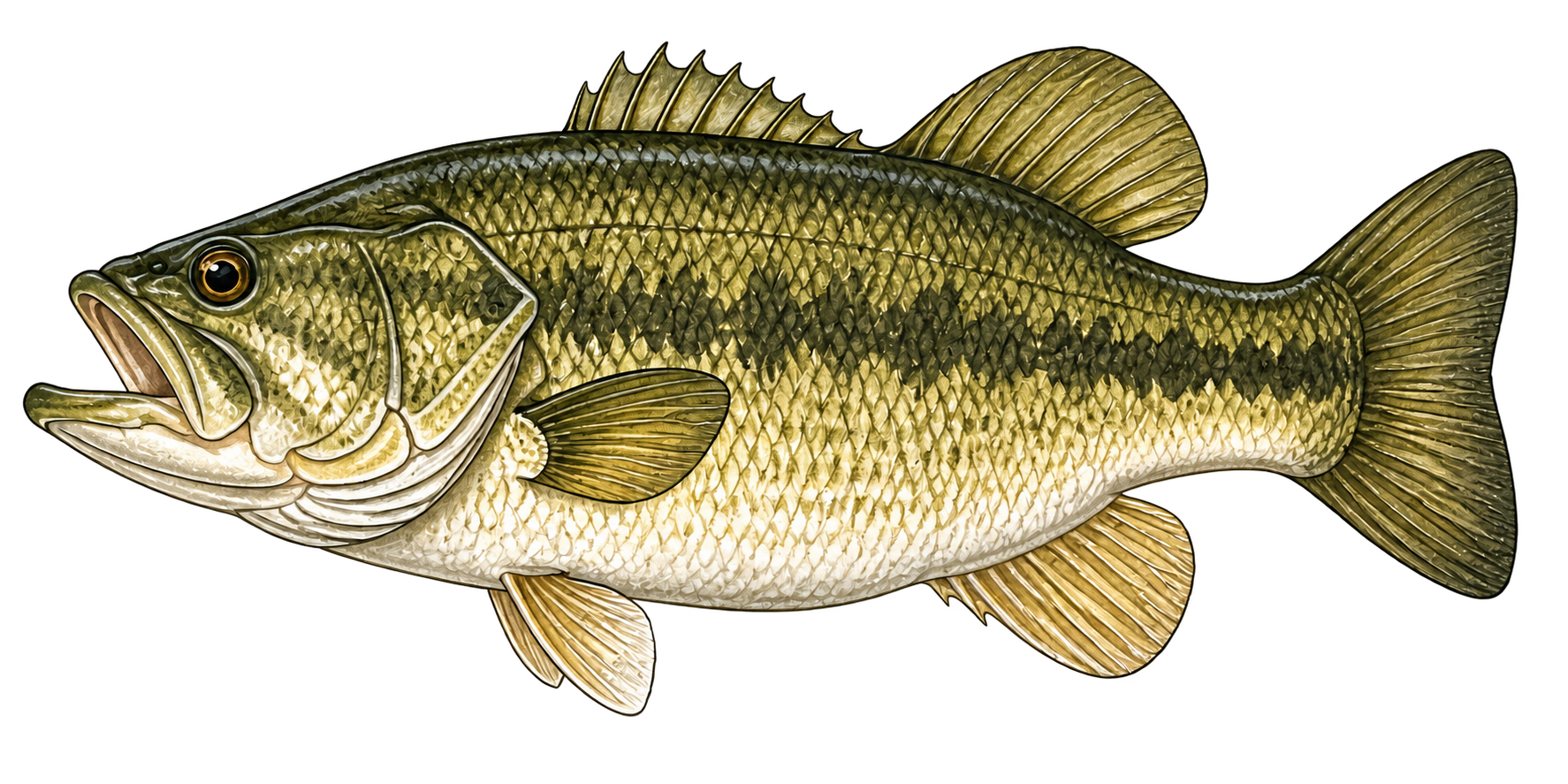
Identification and taxonomy
Largemouth bass belong to Centrarchidae, not the European perch family Percidae. Adults have a robust, slightly compressed body, a large head and a mouth whose upper jaw usually extends beyond the rear of the eye. A dark, sometimes broken band runs along the flank. The dorsal fin has spiny and soft portions separated by a clear notch. Colour varies with bottom, water clarity, vegetation, light and the fish’s condition; juveniles often show stronger markings. Spain retains Micropterus salmoides in its legal classification. A recent taxonomic revision distinguishes largemouth bass as M. nigricans and Florida bass as M. salmoides.
How it senses the water
Vision detects silhouettes, contrast and movement; its usefulness changes with light, clarity, depth and cover. The lateral line senses nearby water movement and pressure changes, helping the fish approach and strike. Smell and taste add chemical information. These senses work together, so prey can remain detectable at close range as visibility worsens. A fish that does not chase visible prey is not necessarily inactive: it may inspect, reposition or decide the energy cost or perceived risk is too high.
Habitat, cover and oxygen
Bass inhabit lakes, reservoirs, ponds and slow to moderately flowing rivers. Vegetation provides shelter, shade and nearby food, but density, edges and oxygen matter. Wood creates ambush positions; rock supports transitions, thermal differences and crayfish. Drop-offs connect shallow and deep water, while open water can hold schools of prey. Cover is useful because of the food and living conditions around it, not simply because an object is present. Warm water increases metabolism only within limits. A deep layer with insufficient oxygen is unsuitable even if its structure looks ideal.
A year governed by the water
Seasonal phases depend on latitude, altitude, flow, reservoir size and local weather rather than month names. Cold water commonly reduces metabolism and lengthens resting periods, but fish still feed when opportunities justify it. As water warms, adults move between winter areas and protected shallows. Before spawning, feeding and reproduction compete for energy. During spawning, stable temperatures and substrate matter more than a fixed date. Afterwards, fish recover and use shade, grass, current, depth or baitfish according to the waterbody. Cooling redistributes food and fish. The seasonal sequence is reversed in the Southern Hemisphere.
Spawning and parental care
Males clear a nest depression, often in gravel or firm substrate, fertilise eggs and guard the nest and early young. Water level stability, temperature and habitat affect success. Around 15–16 °C is a frequently cited reference for the start of spawning activity, not a universal threshold or alarm. Photoperiod, stability and local conditions shift timing. Introduced populations in Brazil can have a prolonged breeding season during the southern spring: calendars from Spain, Texas or Florida cannot be applied worldwide.
Diet changes with growth
Larvae and fry begin with zooplankton and small invertebrates suited to their mouth and swimming ability. Juveniles add aquatic insects, crustaceans and small fish. Adults are often mainly fish-eaters but also exploit crayfish, amphibians and other available prey. Diet varies by place and season. Availability, vulnerability, capture cost, competition and risk influence the choice; being able to eat a prey item does not mean constantly seeking it. This flexibility helps explain both sporting interest and invasive potential outside the native range.
Movement and home ranges
Telemetry reveals different individual patterns. Some fish remain in small sectors that provide food, refuge and suitable depth; others travel farther or change depth. Season, flow, water level, oxygen, prey and disturbance can all alter movement. Cover is a useful location, not a permanent address. Rules such as ‘always deep in winter’ or ‘large fish never leave cover’ are starting hypotheses for observation rather than biological laws.
Native and introduced ranges
In North America, its native range, bass form part of communities that evolved with them and support a major recreational fishery managed through regulation, monitoring and habitat work. Deliberate introductions to Europe, South America, Africa and Asia were largely motivated by sport fishing. They can prey on fauna that did not evolve with this predator and change food webs, although impacts vary between ecosystems. Spain’s official introduction is associated with 1955; Brazilian literature records introduction in 1922. Reservoir connections and later transfers helped their spread.
The legal context in Spain
Black bass are listed throughout Spain in the Spanish Catalogue of Invasive Alien Species. The classification describes ecological risk outside the native range and establishes a management framework. Possession, transport and trade in live specimens are generally prohibited; never move a live bass to another waterbody or release it there. Law 42/2007 allows autonomous communities to regulate fishing and control in certain delimited historical areas under management measures. Whether a catch must be released or removed depends on the applicable regional and waterbody rules. The Spanish catalogue and the EU Union list are different legal instruments: the EU version consolidated on 7 August 2025 does not include Micropterus. Always consult current legislation rather than applying this dated reference automatically.
Responsible handling
Where release is authorised or required, minimise fighting, handling and air exposure. Where removal is required, follow that rule. Prepare pliers, net and camera before lifting the fish. Wet hands protect mucus; a rubber net reduces abrasion and snagging. Support a large fish under the belly as well as the jaw, keeping it horizontal. Unhook and photograph promptly, returning it to the water between operations if needed. Do not pull forcefully on a deep hook; cut the line or use the recommended technique if removal would cause more injury. Release gently without throwing or moving the fish violently backwards and forwards. Hook location strongly affects survival; mouth hooking is generally safer than deep hooking.
Four ideas worth reconsidering
- ‘It does not feed in winter’
- It often feeds less frequently but does not stop feeding. Energy costs and opportunities change.
- ‘It always stays against cover’
- It may suspend, follow prey or use open water. A drop-off can be an unseen structure.
- ‘Spawning starts on the same date each year’
- Temperature helps, but stability, daylight, water level and microhabitat shift the timing.
- ‘Catch and release means taking a photo and putting it back’
- Release is appropriate only where the rules allow it, and handling must minimise fighting, air exposure and injury.
The bass can be an important sport fish in its native range and an invasive species with real impacts where introduced. Understanding both contexts supports better observation and responsible decisions.